
The Role of AI Video Analytics in theFuture of Public Transit
Public transit is going through its biggest change in a generation, and the cameras already riding every bus and rail car have quietly become the most useful tools for making sense of it. Below we walk through what is changing, why it matters, and how forward-looking agencies are turning onboard video into an intelligence platform.
WHAT THIS ARTICLE COVERS
|
BY THE NUMBERS
| 77% | weekend subway recovery versus 66% weekday recovery in 2023, with discretionary travel now more popular than commutation. [mta.info] |
| $17.2B | projected global market for AI-powered transit video analytics by 2031, up from $6.19B in 2026 @ 22.72% CAGR. [Mordor Intelligence.com] |
| 4–5× | global video surveillance data generation rise from 566 petabytes per day in 2015 to over 2,500 petabytes per day by 2019. [IHS Technology, via Unicom Engineering / Security Info Watch] |
THE OLD MODEL
Why is the traditional transit model breaking down?
For most of the twentieth century, transit ran on a simple bargain: put fixed infrastructure along dense corridors, tune it for the morning and evening peaks of the nine-to-five economy, and judge success by passengers moved per hour. That bargain is coming apart, and the forces pulling it apart are permanent rather than temporary.
Remote and hybrid work broke the peak. In major North American metros, Tuesday through Thursday now carry the heaviest downtown rail loads, while Monday and Friday look more like the old Saturdays. Midday demand has grown near medical campuses, distribution centers, and community colleges. The suburb-to-suburb reverse commute has grown faster than any downtown radial line.
Rideshare and micromobility did more than pull riders away. They reset what riders expect. Someone who can summon a shared vehicle in three minutes is less willing to walk six blocks, wait twelve minutes, and transfer twice. Transit still wins on cost and environmental footprint, but only when the service is reliable enough to trust.
“The question is no longer how many people transit can move on its best corridor at its best hour. It is whether transit can become the connective tissue of an entire mobility ecosystem, everywhere, all day, responsive to how people actually live rather than to an industrial-era schedule.” – Nima Ostad, COO Safety Vision
Equity adds urgency. A 2024 Federal Transit Administration report found that 97% of reporting agencies cut service during the pandemic, and that those cuts disproportionately hit essential workers and disadvantaged communities; the very riders who never stopped riding.
THE EMERGING PARADIGM
What replaces the fixed-route model?
The agencies making this shift well are not just adding routes or buying electric buses. They are rebuilding around a different operating logic: sense continuously, analyze in real time, and respond as conditions change. The industry has started calling this the Flexible Mobility System. Four traits separate it from the legacy model:
- ▪ Demand-responsive service design. Routes and frequencies get adjusted seasonally, monthly, or daily from observed origin-destination patterns instead of annual planning cycles.
- ▪ Network-level connectivity. Transit becomes one layer in a multi-modal stack, with integrated ticketing, live micromobility connections, and guaranteed timed transfers.
- ▪ Continuous operational intelligence. Decisions run on live data from every vehicle, stop, and passenger interaction rather than monthly ridership reports printed weeks late.
- ▪ Proactive safety and reliability. Incidents get caught and handled before they cascade into disruptions, with automated escalation instead of reactive dispatch.
None of this depends on a single breakthrough. It comes from mobile connectivity, edge computing, and machine learning meeting infrastructure transit already owns: a fleet that reaches every corner of every city it serves, with cameras already on board.
THE SURVEILLANCE LAYER, REIMAGINED
How does a security camera become a mobility sensor?
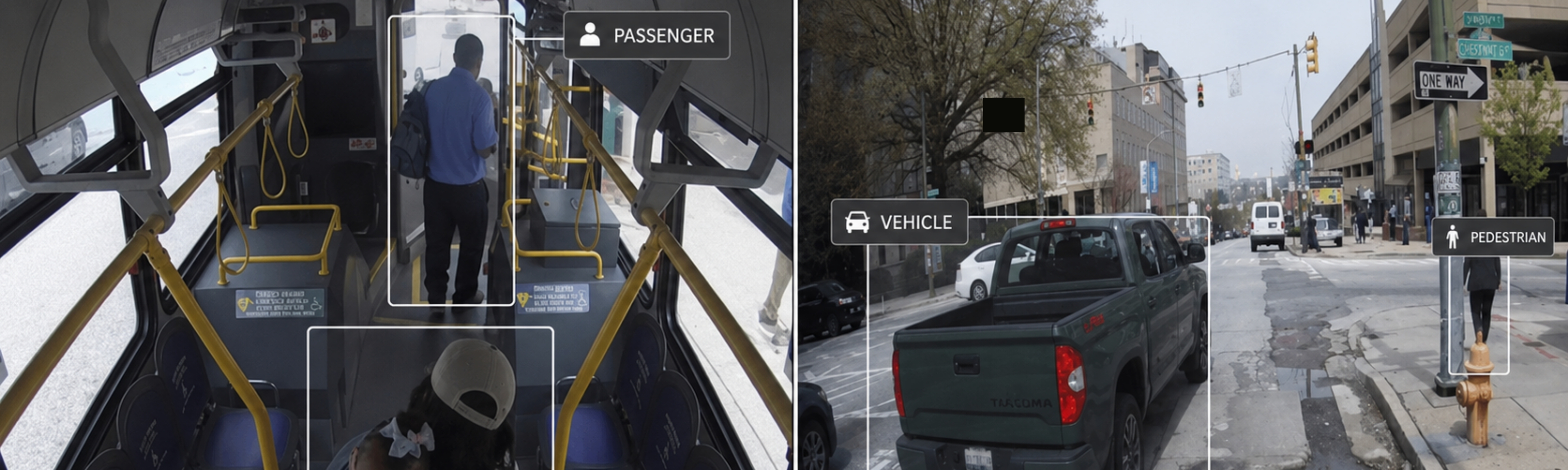
Onboard video started as an evidence tool. It deterred fare evasion, documented accidents, and gave law enforcement a record. In that role it has worked well. But the question has changed.
If there are high-resolution, AI-capable cameras on every vehicle, what else can they tell us? The answer covers most of what a dynamic, data-driven system needs to run. Four applications are leading the way.
1. Passenger counting and load intelligence
Older automatic passenger counters used infrared beams or pressure mats and gave a yes-or-no signal: someone boarded or got off.
Stereo video analytics give a much fuller picture. They count load by door and by segment across the day, flag the stops where long dwell times drag the schedule, and model crowding two or three stops ahead. Fed to a central platform in real time, that data drives dynamic capacity management. Dispatchers, or automated systems, can slot short-turn vehicles onto crowded segments and tell riders about conditions before they reach the stop.
2. Incident detection and safety intelligence
The old model waits for a driver to notice a problem, size it up, and decide whether to call dispatch. That works for the obvious events. It fails for the quiet ones, like the passenger in medical distress near the back or the argument that has not yet turned into a fight, which are exactly the ones where early action helps most.
Computer vision at the edge now catches a wide range of conditions: a posture that suggests a fall or medical event, behavior linked to aggression, someone tampering with a driver barrier, and smoke or fire in the cabin. Detection in milliseconds replaces the minutes it takes a situation to reach the driver.
“The best safety outcome is the one that never had to happen. When a mobile video system can flag a supervisor the moment a situation starts to develop, instead of after it becomes a headline, the whole calculus of safety changes.” -Lou Quaglia, Director Mass Transit
Integration matters as much as detection. An alert that flows straight into computer-aided dispatch, opens an incident record on its own, and reaches the nearest supervisor without a manual relay is a different thing entirely from a camera that only records for review after the fact.
3. Driver behavior analytics and risk management
Forward-facing cameras paired with inertial sensors and GPS keep a running record of how each vehicle is driven. Machine-learning models trained on thousands of hours of footage pick out hard braking, tailgating, distraction, and fatigue while the pattern is still forming, not only after a crash. The programs that work best treat this as coaching, not surveillance. Where agencies run transparent, feedback-first monitoring — drivers seeing their own scores, coaches using footage to teach — collision reductions of 20 to 40 percent are well documented: Element Fleet calls 20 percent a conservative outcome for telematics-based coaching. Insurers have noticed, and premium cuts in that range are now on the table for agencies that can show a mature program.
4. Equity sensing and corridor intelligence
The most overlooked benefit is the ability to surface what usually stays invisible.
A 6 a.m. shift-change route through a warehouse district can carry more standing riders per revenue mile than a peak-hour downtown express, but because that load never gets counted, the route stays under-resourced year after year.
When every vehicle produces the same quality of occupancy data no matter which corridor it runs, the system stops quietly favoring the corridors that already get attention. Equity audits that once needed dedicated observers can run on their own, continuously, across the whole network.
THE GOVERNANCE IMPERATIVE
Doesn’t all this data create privacy risk?

It does, and that is the reason governance has to come first. These capabilities are powerful, and handled carelessly they are dangerous. A system that generates rich behavioral data about riders needs a framework built as carefully as the technology itself. The agencies leading here have stopped treating privacy as a compliance checkbox and started treating it as a design constraint: collect the minimum, enforce retention limits in the architecture rather than in policy memos, and keep access logs that can be audited. Privacy by design is not optional.
LOOKING AHEAD
Where is transit intelligence headed next?

As edge-computing costs keep falling and 5G reaches more of the city, the gap between an event on a vehicle and an intelligent response will continue to shrink. The fleet starts to work as a distributed sensor network, and the operations center starts to work as a real-time nervous system. The sharpest competition among agencies will not be about who has the newest buses. It will be about who can turn the data coming off their video and telematics systems into decisions that improve the rider experience faster than the platforms fighting for the same trips.
The agencies that come out ahead already share a few visible traits today: continuous operational intelligence, integrated data systems, in-house analytical capacity, and enough public trust to expand what they do without triggering a backlash.
THE BOTTOM LINE
The camera used to be a window. Now it is a door.

Mobile video went onto transit vehicles to protect passengers and document incidents, and that job has not gone away. If anything, riders expect more of it than ever. But the systems going in today do something bigger. They turn a passive recording tool into an active intelligence platform. The move from fixed-route, peak-commuter transit to flexible, data-driven mobility is not really a technology story. It is a story about organizations learning to sense the network as it runs, respond as conditions change, and earn the rider trust that makes new capability politically durable.
Mobile video intelligence runs through all of it. Not because cameras are special, but because they are already everywhere, on every bus, on every train, in every neighborhood, generating the data a modern mobility system needs. The question for transit leaders is not whether to use that data. It is whether to use it deliberately, with clear purpose and strong governance, before the window for doing it thoughtfully closes.
The cities that get transit right this decade will be the ones that figured out, early enough, that the intelligence they needed was already riding with them.

Discover More

COPYRIGHT © 2026 SAFETY VISION,LLC. ALL RIGHTS RESERVED.
PRIVACY POLICY | TERMS OF USE | ACCESSIBILITY | COOKIE PREFERENCES